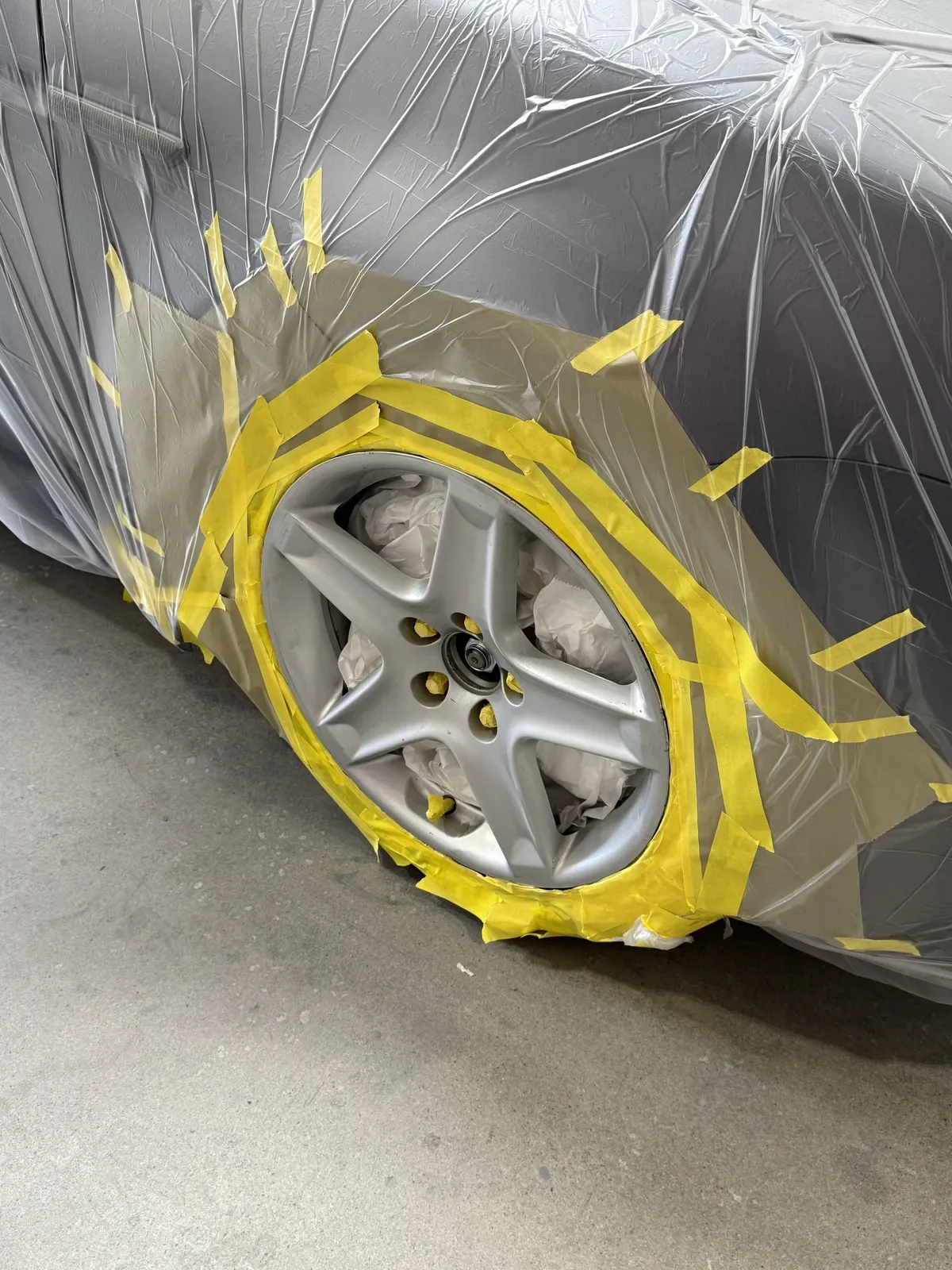
Wheel & Rim Repair // SkillVerify™ certification
Certified means proven.
Every level is awarded for work an instructor watched you do, rated and written down with the evidence. Attendance and years in the trade do not count on their own. Here is exactly how you earn yours.
01 // Four levels
Foundation to master.
You climb one level at a time. Each one asks for more evidence than the last, and none of them can be bought with seat time.
Wheel Repair Foundation
Wheel types and finishes, the safety boundaries, and the triage call on whether a wheel can be cosmetically repaired at all.
Evidence required. Knowledge and safe damage triage, plus supervised tool demonstrations.
Cosmetic Wheel Repair Technician
A complete, approved repair from intake to final inspection on either the retail or the wholesale path.
Evidence required. An approved retail or wholesale practical path, with every mandatory safety gate passed.
Advanced Wheel Refinishing Technician
Both paths, advanced color matching and complex cosmetic contours.
Evidence required. Retail and wholesale paths, advanced color matching and complex approved contours.
Master Wheel Appearance Technician
Consistent quality over many repairs, diagnostics, and the ability to mentor other technicians.
Evidence required. Repeated quality consistency, diagnostics, mentoring and independent review.
02 // Two endorsements
Retail and wholesale.
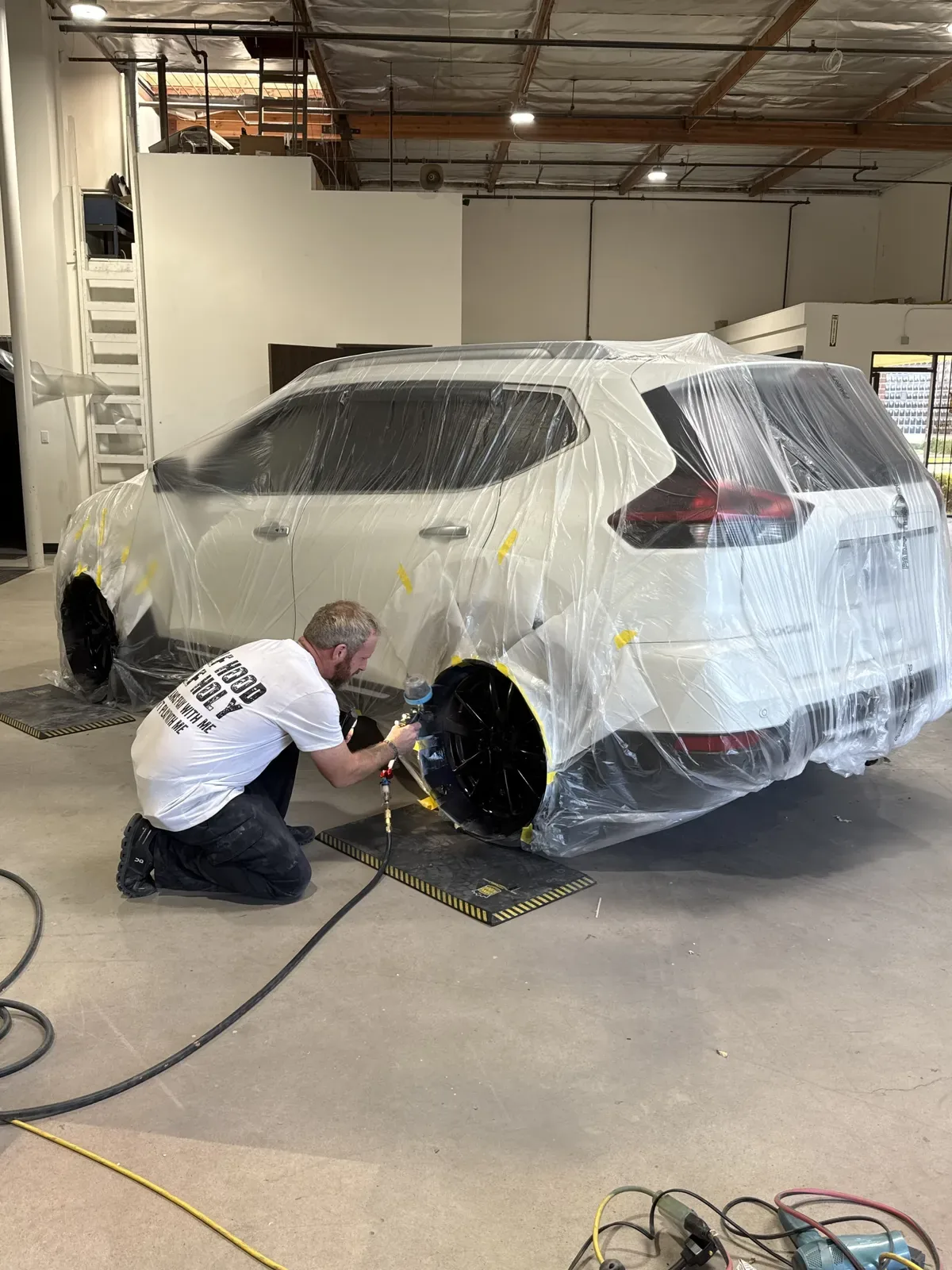
Retail is the individual customer at the curb or the driveway. It follows the full eighteen-step process, with exact color matching, filler, primer and a factory-grade clear. More time per wheel, a higher price per wheel, and a customer who tells their friends.
Wholesale is the dealership, the fleet, the tire shop and the reseller. It is a faster six-step sequence matched to a standard specification, priced for volume, and assessed on the clock.
They are separate endorsements on your certificate, but they share one safety standard. A rush order never gets to skip a stop-work decision.
03 // The rating scale
35 competencies, rated zero to four.
Your instructor rates each competency and records the evidence or the exact action they observed, never just a number. Five of them are mandatory and safety-critical: A03, B01, B02, B04, C03. Those cannot be skipped and need a three or better.
- 4
Consistently proficient
Performs it every time and can explain the judgment behind it.
- 3
Independent and acceptable
Performs it alone to an acceptable standard.
- 2
Partially demonstrated
Gets there with coaching. Not yet at standard.
- 1
Unsafe or incorrect
Unsafe, incorrect, or needed extensive intervention.
- 0
Not demonstrated
The skill was not shown.
04 // The competency map
What you are rated on.
Six groups, from intake to delivery, each tied to the steps in the Ding King Alloy Wheel Repair Manual. Highlighted codes are mandatory.
AIntake, Materials & Repairability5 competencies
- A01Identify wheel type and finish, painted versus machined or polished
- A02Classify curb rash, scratches, gouges, corrosion and prior repairs
- A03Recognize cracks, bends, bead-seat and mounting damage, then stop and refer Mandatory
- A04Document damage, repair scope, finish and customer authorization
- A05Choose the retail or wholesale workflow and justify its limits
BSafety, Tools & Work Setup5 competencies
- B01Select PPE and chemical controls from the SDS and TDS Mandatory
- B02Verify spray-area ventilation and equipment readiness Mandatory
- B03Know the grinder, DA sander, abrasives, masking and spray gun
- B04Protect tire, valve, rotor, caliper, mounting and lug surfaces Mandatory
- B05Handle removal, reinstallation referral and torque records
CCleaning, Sanding & Restoration7 competencies
- C01Deep-clean, degrease, dry and inspect the wheel
- C02Choose the abrasive progression and feather the edges
- C03Keep the original contour without removing too much metal Mandatory
- C04Decide whether UV filler is permitted and necessary
- C05Apply, cure and shape UV filler to the product TDS
- C06Eliminate pinholes, waves and scratches before primer
- C07Prepare the blend area and prevent contamination
DPriming, Color & Spray Setup7 competencies
- D01Select a compatible primer and respect flash and cure
- D02Identify the wheel color with the chip deck under controlled light
- D03Find the formula in PPG LINQ or an approved system
- D04Weigh toner increments in grams, taring between each
- D05Calculate the reducer addition from the current TDS
- D06Set the gun and read spray patterns on a spray-out card
- D07Lay an even basecoat with no contamination or mottling
EClearcoat, Cure & Final Finish6 competencies
- E01Identify clearcoat, activator and mixing requirements
- E02Pick temperature-appropriate products from the TDS
- E03Apply clear within film-build and flash requirements
- E04Recognize and correct allowed defects after cure
- E05Verify color, gloss, texture, contour and overspray
- E06Document curing, safe handling and return to service
FBusiness Workflows & Quality5 competencies
- F01Run the complete retail workflow and its quality gates
- F02Run the wholesale workflow without bypassing safety
- F03Estimate materials and time and set realistic expectations
- F04Clean the spray gun and dispose of waste correctly
- F05Take before and after photos and get instructor sign-off
05 // Practical examination
Six stations. Every one observed.
Each station is timed, the products and batch numbers are logged, and before and after photos are captured. The result is complete, remediation, or hold.
Safety and repairability
Setup. Five varied wheels or calibrated images, at least one of them not repairable.
To pass. Every critical defect correctly classified and escalated, with accurate documentation.
A03 · B01 · B02
Retail preparation and contour
Setup. A painted alloy wheel with moderate curb rash.
To pass. Clean, mask, feather and restore the contour without removing excess metal.
B04 · C01–C07
UV filler and primer
Setup. An approved cosmetic gouge on a training wheel.
To pass. Filler applied and cured to the TDS, a smooth contour and a compatible primer.
C04–C06 · D01
Color mixing and spray calibration
Setup. Chip deck, formula access, toners, scale and gun.
To pass. Accurate selection, tare and mix, and an acceptable spray-out.
D02–D06
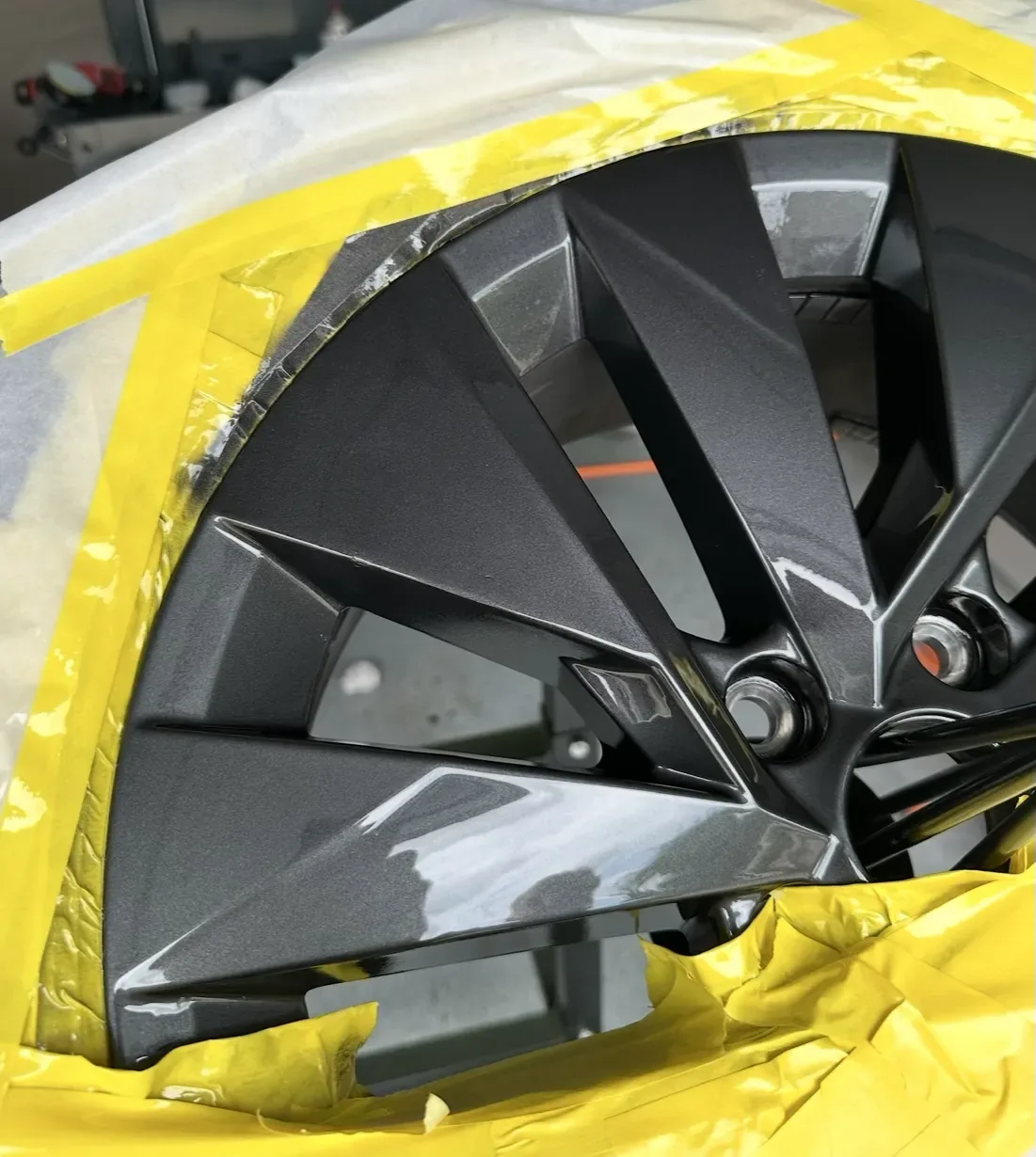
Retail coating and inspection
Setup. A prepared training wheel.
To pass. Uniform base and clear, a documented cure, and a color, gloss and texture inspection.
D07 · E01–E06 · F01
Wholesale timed workflow
Setup. An approved light cosmetic defect, on the clock.
To pass. An efficient, complete process with no skipped safety gate and approved quality.
F02 · F03 · F05
06 // The knowledge exam
Forty questions. Real decisions.
Forty scored items are drawn at random from a reviewed question bank, and almost a third of them are photo scenarios where you decide whether a wheel can be repaired at all. Then your instructor asks you to talk through decisions out loud.
| Items | Topic |
|---|---|
| 12 | Photo-based damage and repairability scenarios |
| 8 | Tools and safety |
| 8 | Surface preparation |
| 8 | Color and coating |
| 4 | Quality and business |
A wheel has a visible crack near a spoke. What is the next action?
Stop the cosmetic repair, document it, and refer the wheel for specialist or OEM-guided evaluation.
The wheel is diamond-cut, but the available procedure is a painted spot repair. What must be explained?
That the repair cannot be represented as restoring the original machined finish.
The shop changes clearcoat brands. Can the old 4:1 ratio be reused?
No. Check the new product’s current TDS, activator and application conditions.
A wholesale order is due today, but the wheel appears bent. What happens?
The same stop-work gate applies. Speed and price never override safety.
07 // Safety boundaries
Signed before any wheel is touched.
You and your instructor both sign these six boundaries before the first practical begins. They apply to retail and wholesale work equally.
Stop and refer any suspected crack, significant bend, deformation, bead-seat, lug-seat or hub-mounting damage, or air leak. Never hide it with filler or coatings.
Check current OEM wheel repair restrictions. Not every cosmetic defect is repairable.
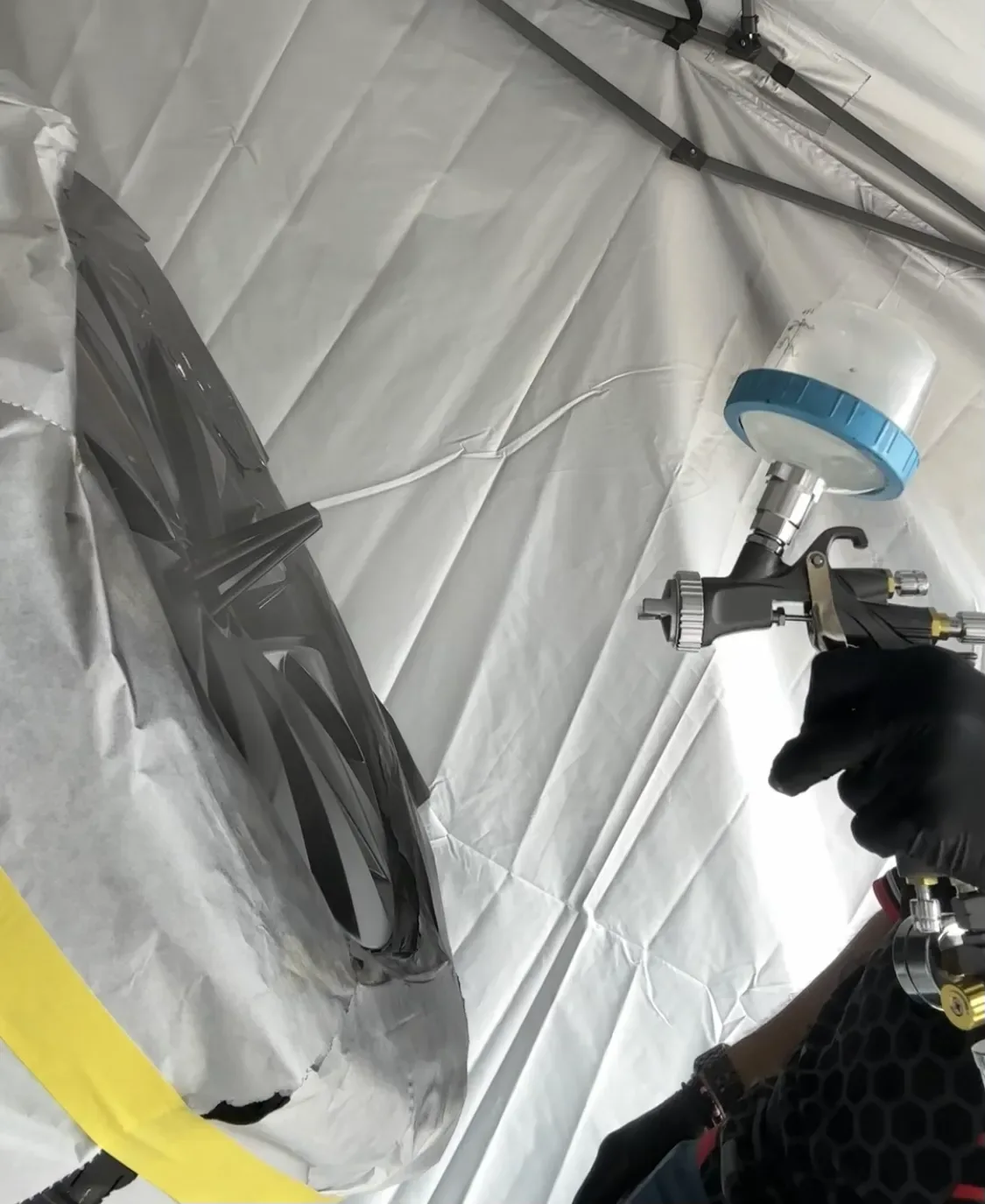
Spray only in a compliant area with ventilation and a respiratory program suited to the coating and dust.
Follow the current SDS and TDS for every filler, primer, basecoat, reducer, clear and activator. No generic number overrides the product.
Keep coatings off bead seats, hub mating faces, lug seats and valve components.
Use approved lifting, tire handling, mounting, balancing and torque procedures, and refer anything beyond cosmetic scope.
08 // Automatic holds
Safety is never averaged away.
Any of these stops the test on the spot. The event is documented, the work area secured, remediation assigned, and an independent reviewer signs off before a retest. A higher score somewhere else does not cure a hold.
- Proceeding with suspected structural damage, a prohibited repair or an unresolved tire or wheel safety condition
- Removing excessive metal or changing the wheel contour beyond cosmetic scope
- Spraying with unsafe respiratory controls or outside approved site conditions
- Coating mounting, lug or bead contact surfaces
- Lifting, tire work, mounting or torque without authorization or a safe procedure
- Ignoring incompatible chemistry or bypassing a mandatory cure or inspection gate
09 // Weighted scorecard
Where your score comes from.
To be awarded a level you need all four of these: a weighted score of 85% or higher, at least a three on every mandatory competency, every required practical station completed, and zero unresolved holds. A number on its own never issues a credential.
SkillVerify™ certifies cosmetic alloy wheel refinishing only. It does not cover structural repair, welding, straightening, machining or tire service.
Classes start every Monday
Earn your
SkillVerify™ level.
 Apply for a Student Loan