Courses // Add-on services
Make every wheel new again.
Hands-on curb rash and alloy wheel repair training, taught by working professionals. You leave certified, equipped, and ready to take paying work the week you get home.
- Length
- 3 days
- Curriculum
- 16 modules · 195 skills
- Assessment
- 6 exams + capstone
- You earn
- SkillVerify™ certification
- Starts
- Classes start every Monday
01 // The opportunity
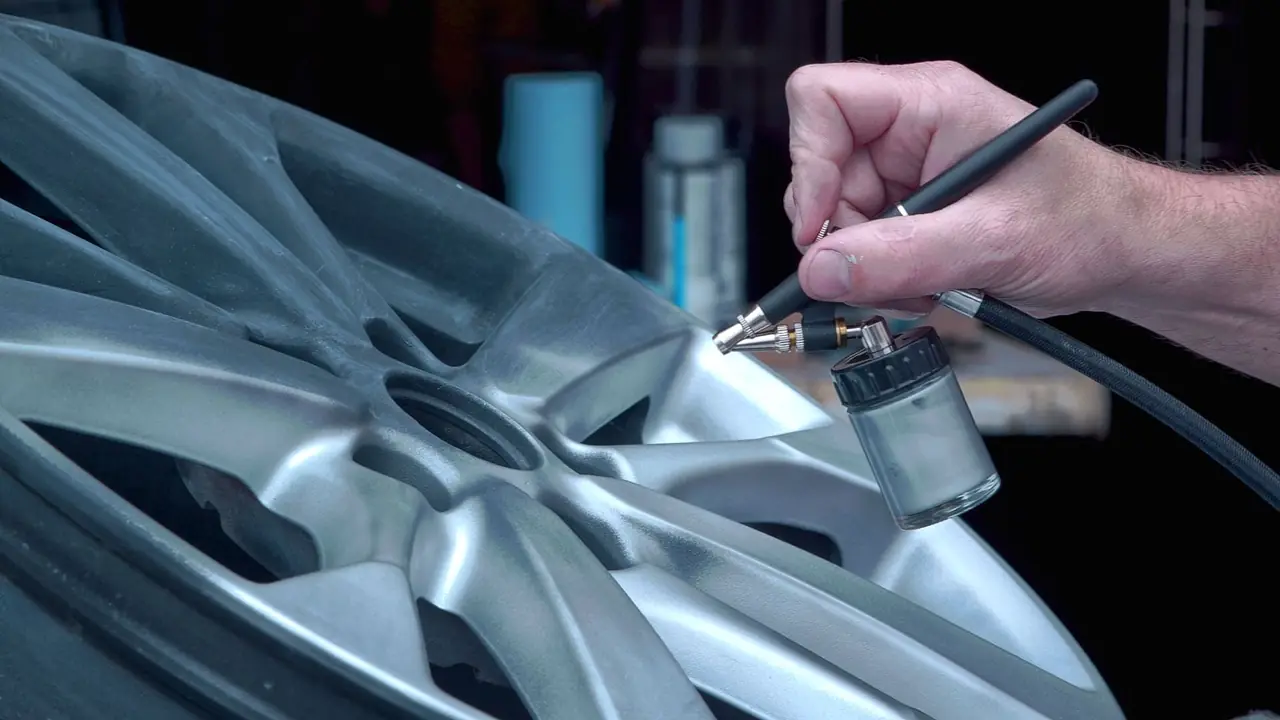
Most drivers are told a scraped wheel has to be replaced. Our graduates repair it in under thirty minutes, with the wheel still on the car, and hand it back looking like it left the factory.
02 // Before and after
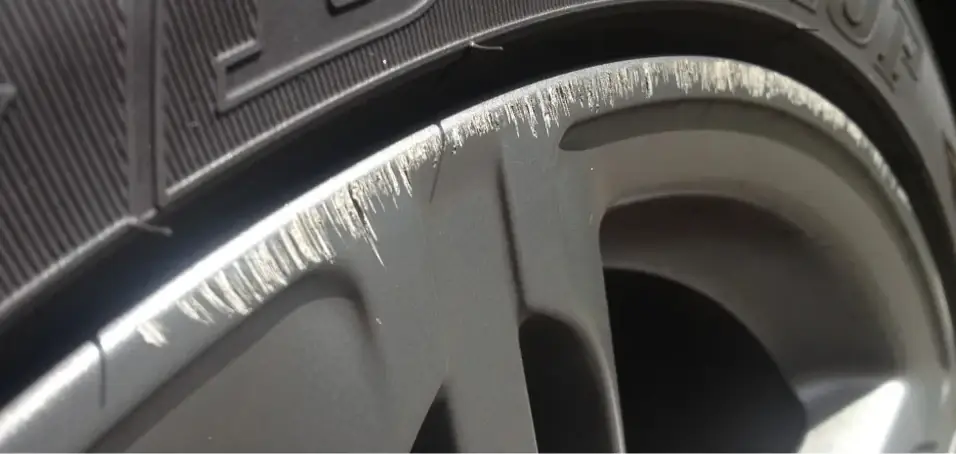
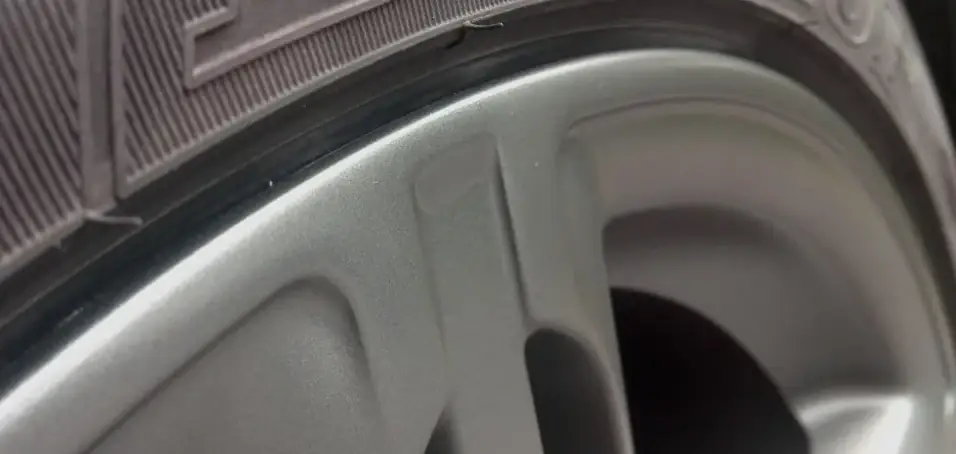
The proof is in the lip.
Curb rash, gouges, nicks, scuffs, corrosion and tired, faded finishes. You learn to read the damage, bring back the original contour, match the color, and lay down a clearcoat that disappears.
Customers who expected to buy a new wheel are usually the ones who send you their friends.
Four moves, done right.
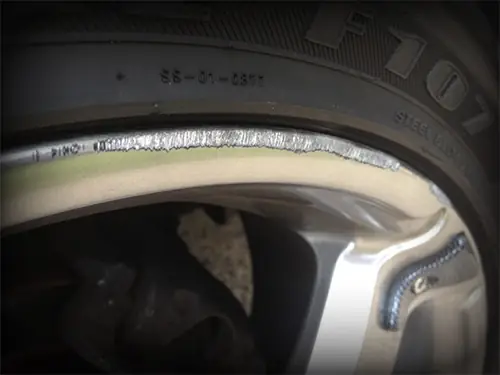
A repair that lasts comes from doing a few things in the right order with real care. These are the four you will practice until they feel automatic.
Assess
Classify the damage and confirm it is cosmetic before anything else happens.
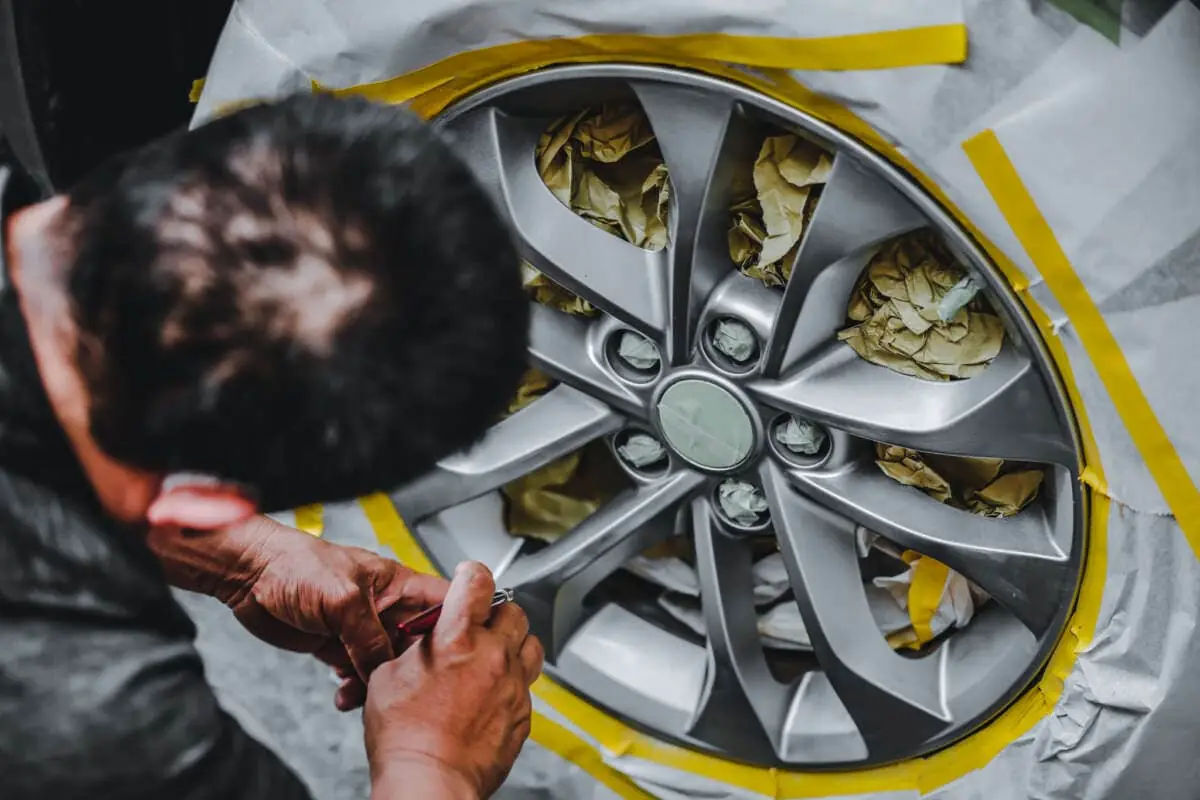
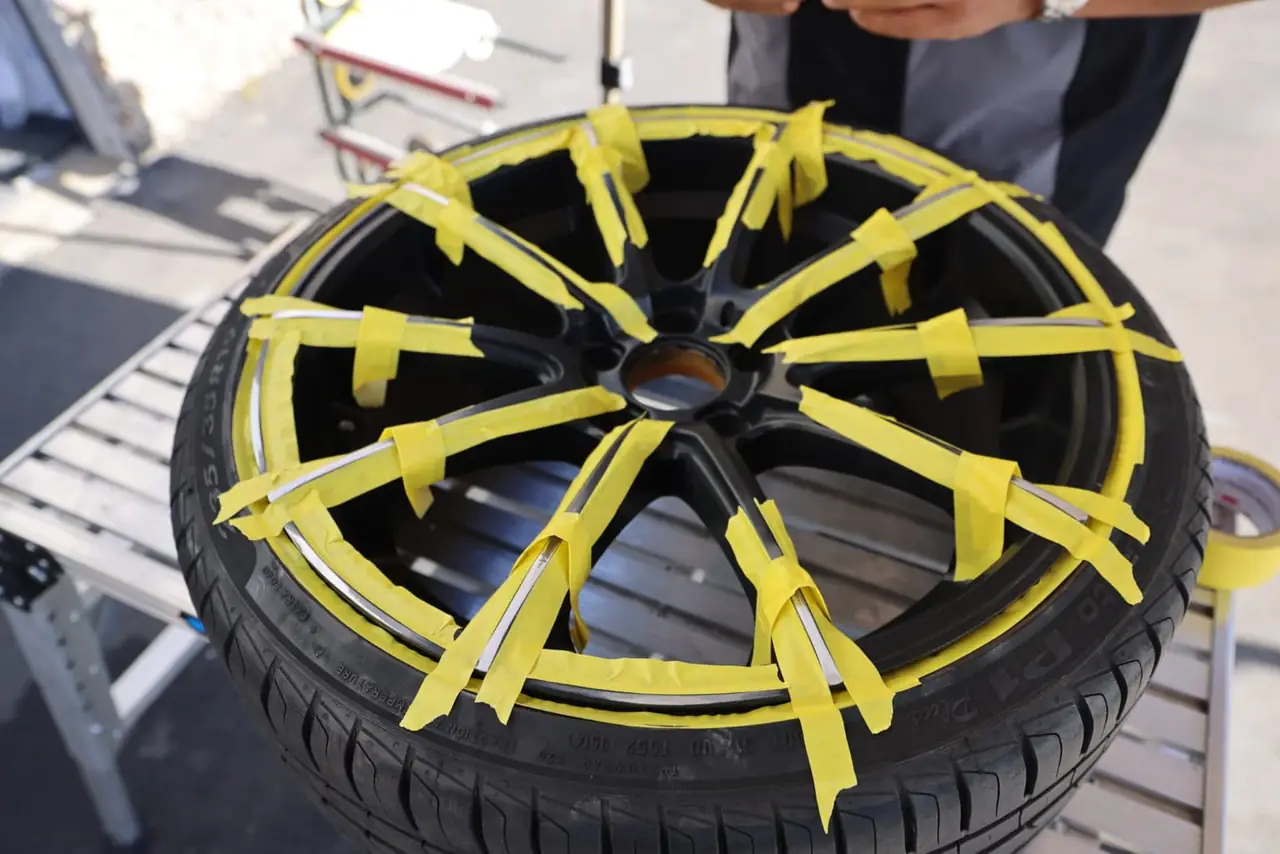
Protect
Tire, valve stem, sensor and lug seats are covered and the repair boundary is set.
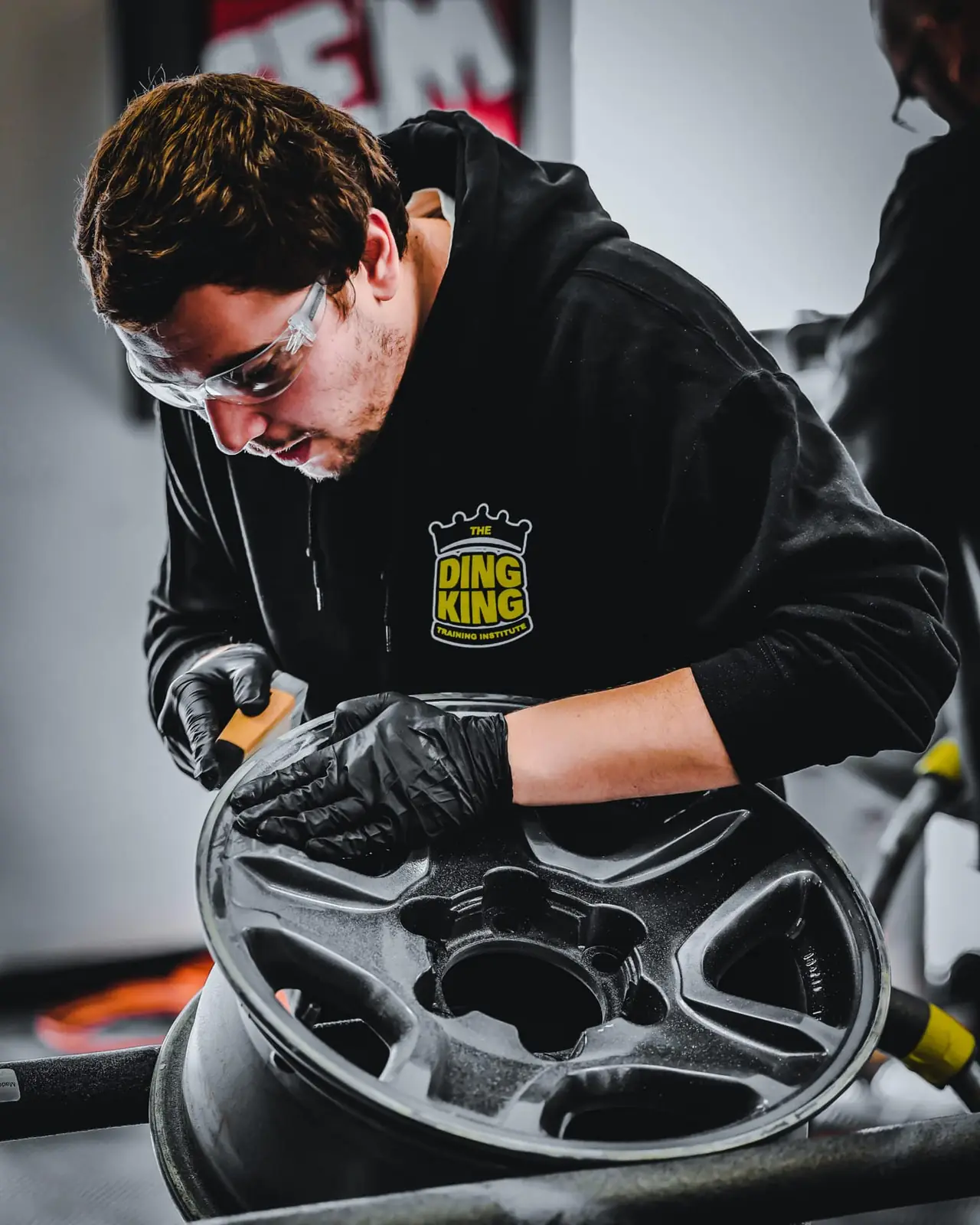
Restore
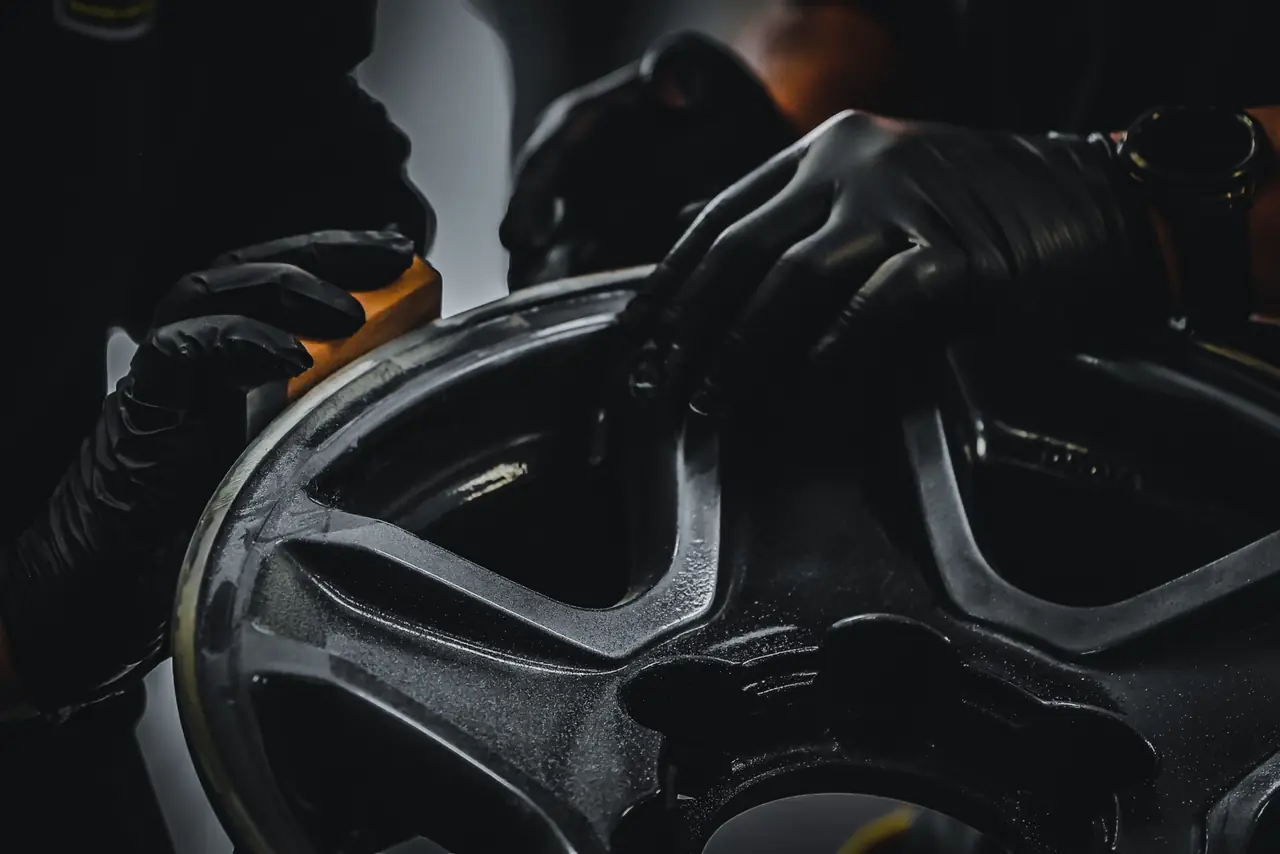
Controlled sanding brings the lip back to its original contour, with no flat spots.
Refinish
A matched basecoat, a blended transition, and a clearcoat that protects it all.
03 // What you leave with
Five things most schools skip.
Plenty of courses hand you a certificate and wish you luck. We send you home with proof of skill, the tools to do the work, people who pick up the phone, and a plan for finding your first customers.
Certification, earned, not attended.
SkillVerify™ certification means an instructor watched you do the work. Each of the 195 skills in the program is rated, and you sit six practical exams before your capstone: a damaged alloy wheel that you assess, plan and restore on your own, start to finish.
How certification worksTraining, on real wheels, real cars.
Theory gets you started and the hours on the wheel make you good. You practice on actual vehicles with a working wheel refinisher at your shoulder, so the first customer wheel you touch at home is nowhere near your first real wheel.
Explore the curriculum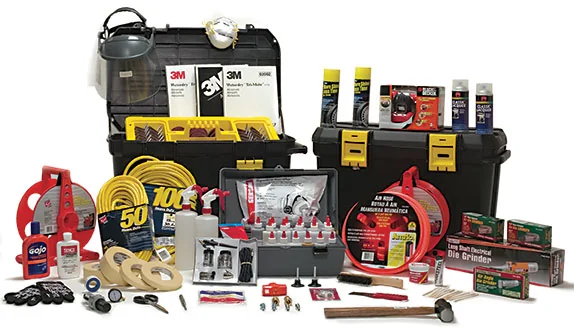
Equipment, ready on day one.
You go home with the Ding King Alloy Wheel Repair System and the reference manual that goes with it. It is the same kit you trained on, so when you get home you can open the case and get to work without guessing.
See the system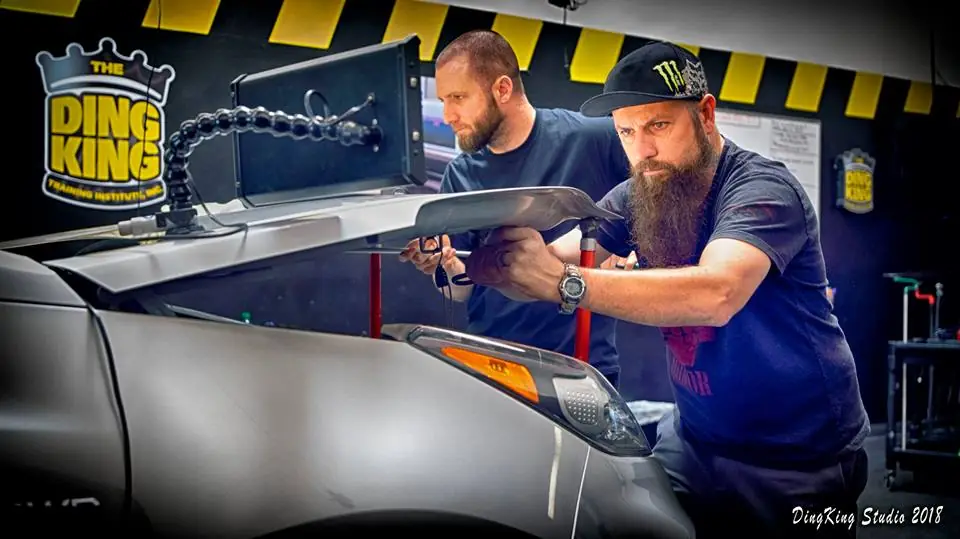
Support, long after graduation.
Graduates keep their instructors’ phone numbers. If you hit an unusual finish or a repair that will not behave, you call someone who has seen it before. That stays true for as long as you are in business.
How coaching works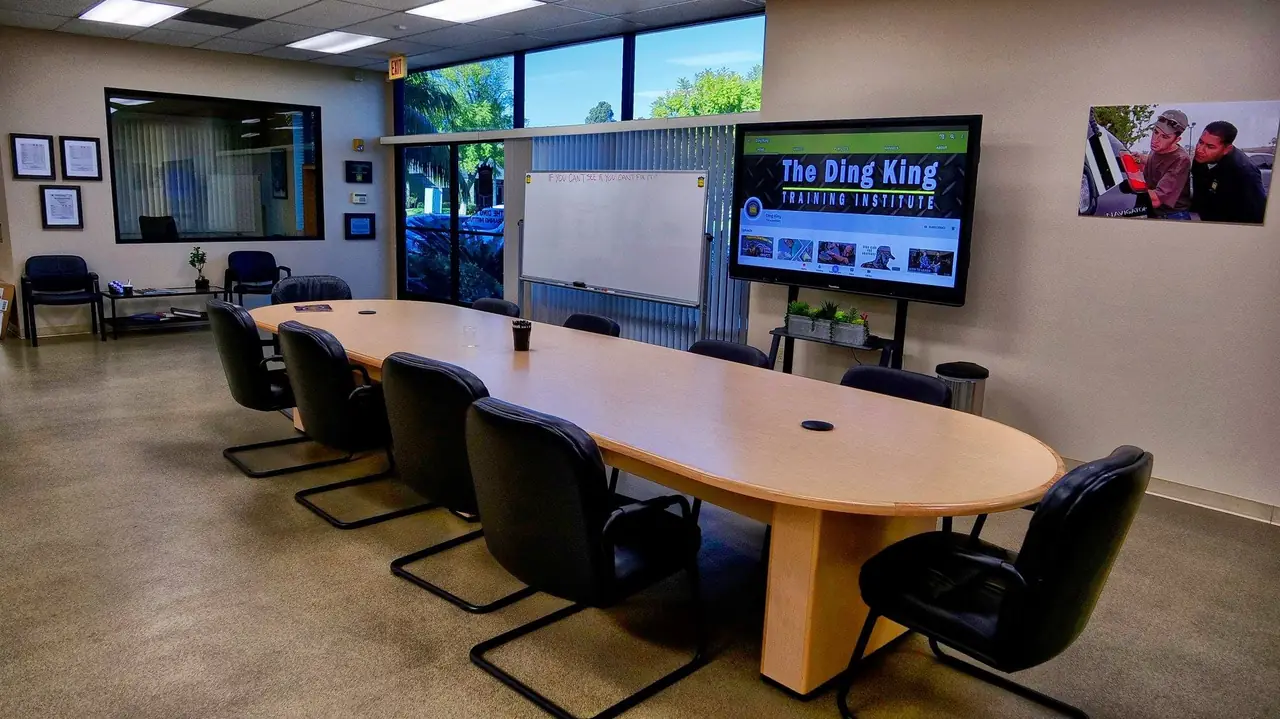
Business, and the marketing to grow it.
Every graduate sits in on the King’s business and marketing class, with one-on-one consulting afterwards. It covers setting up your company, pricing, landing dealer accounts, and getting found online, so the phone rings once you are trained.
The business program04 // The curriculum
Sixteen modules. Nothing left to chance.
The program follows the SkillVerify™ Curb Rash and Alloy Wheel Repair assessment, in the same order a real repair happens. You start by learning when not to touch a wheel, and you finish by pricing and documenting the job for the customer.
Assess
Read the wheel and make the safety call before you touch it. This is where you learn which wheels to walk away from.
Modules 1–2Prepare
The right tools, a protected tire and valve stem, and a surface clean enough that nothing you apply later can fail.
Modules 3–5Restore
Sand, fill, mask and prime until the lip has its original contour back, with no flat spots and no ridges.
Modules 6–9Refinish
Match the color, lay the base and the clear, and correct any defect before the customer ever sees it.
Modules 10–14Deliver
Inspect under good light, document the job, price it fairly, and hand the car back with confidence.
Modules 15–16
Every skill. All 195 of them.
We publish the full SkillVerify™ curriculum openly. Your instructor demonstrates each skill, you practice it, and it is rated before you certify. Open any module to read every skill.
01Wheel Identification & Damage Assessment16 skills · Wheel Identification & Damage Assessment
- 1.1Identify cast, forged, and flow-formed alloy wheels
- 1.2Distinguish aluminum alloy, steel, and specialty wheel materials
- 1.3Identify painted, powder-coated, polished, machined, and diamond-cut finishes
- 1.4Recognize OEM versus aftermarket wheels
- 1.5Identify clear-coated versus uncoated surfaces
- 1.6Identify curb rash, scratches, chips, gouges, and abrasion
- 1.7Measure damage depth and affected surface area
- 1.8Evaluate damage along wheel lips, spokes, faces, and edges
- 1.9Identify cracks, bends, distortion, and other potential structural damage
- 1.10Recognize corrosion and finish deterioration
- 1.11Identify previous wheel repairs and refinishing
- 1.12Inspect for tire sidewall damage associated with curb impacts
- 1.13Identify wheel damage requiring further specialist inspection
- 1.14Determine whether cosmetic repair is permitted under applicable manufacturer guidance
- 1.15Determine when wheel replacement or an authorized specialist evaluation is required
- 1.16Photograph and document all pre-existing damage
02Wheel Safety & Repairability Decisions13 skills · Safety & Repairability Decisions
- 2.1Distinguish cosmetic damage from potential structural damage
- 2.2Identify cracks, deformation, and damage near load-bearing areas
- 2.3Recognize signs of air leakage and bead-seat damage
- 2.4Identify damage involving lug holes, mounting faces, and hub contact surfaces
- 2.5Evaluate whether the proposed repair would remove excessive material
- 2.6Identify restrictions on machining, welding, heating, and straightening
- 2.7Follow applicable OEM wheel repair and replacement policies
- 2.8Recognize wheels that must not undergo cosmetic refinishing
- 2.9Understand limitations of cosmetic fillers
- 2.10Avoid using fillers to conceal structural damage
- 2.11Identify conditions requiring wheel and tire removal
- 2.12Demonstrate correct stop-work and escalation procedures
- 2.13Explain repair limitations and safety concerns to customers
Trying to cosmetically hide a crack, a bend, an unsafe bead seat or any other suspected structural defect, instead of stopping and referring the wheel, is an automatic failure of the practical assessment.
03Tools, Equipment & Materials14 skills · Tools, Handling & Preparation
- 3.1Identify sanding discs, abrasives, blocks, and rotary tools
- 3.2Select appropriate abrasive grits
- 3.3Identify dual-action sanders and precision sanding tools
- 3.4Select suitable surface preparation equipment
- 3.5Identify compatible wheel refinishing fillers and glazing materials
- 3.6Select primer and adhesion-promoting products
- 3.7Identify wheel-specific basecoats and clearcoats
- 3.8Understand aerosol, airbrush, and spray-gun application methods
- 3.9Select appropriate masking materials
- 3.10Identify wheel stands and secure workholding equipment
- 3.11Use appropriate lighting for damage and finish inspection
- 3.12Inspect equipment for safe operating condition
- 3.13Maintain clean, organized tools and supplies
- 3.14Prevent contamination between sanding, preparation, and coating operations
04Wheel Removal, Handling & Protection13 skills · Tools, Handling & Preparation
- 4.1Determine whether the wheel can be safely serviced on the vehicle
- 4.2Identify situations requiring wheel removal
- 4.3Use manufacturer-approved lifting and support procedures
- 4.4Protect wheel surfaces during handling
- 4.5Protect valve stems, TPMS components, and tire sidewalls
- 4.6Protect lug seats and mounting surfaces
- 4.7Secure wheels properly during repair
- 4.8Avoid damaging tire beads and wheel edges
- 4.9Maintain correct wheel-to-vehicle identification
- 4.10Inspect wheel mounting hardware
- 4.11Follow approved torque procedures when reinstalling wheels
- 4.12Verify TPMS and wheel-related functions where applicable
- 4.13Identify when a qualified tire technician must perform mounting, balancing, or related operations
05Surface Cleaning & Preparation10 skills · Tools, Handling & Preparation
- 5.1Remove brake dust, grease, road film, and contaminants
- 5.2Select appropriate wheel-safe cleaning products
- 5.3Identify sensitive coatings and bare metal
- 5.4Remove loose or failing finish only where appropriate
- 5.5Clean and degrease repair areas
- 5.6Evaluate existing finish adhesion
- 5.7Establish appropriate repair boundaries
- 5.8Protect undamaged areas
- 5.9Prepare surfaces for sanding and refinishing
- 5.10Verify surfaces are dry and free of contamination
06Curb Rash Sanding & Surface Restoration13 skills · Sanding & Contour Restoration
- 6.1Select appropriate initial abrasive grit
- 6.2Demonstrate controlled sanding pressure
- 6.3Remove minor surface abrasions without unnecessary metal removal
- 6.4Feather damaged coating edges
- 6.5Maintain original wheel lip contours
- 6.6Avoid creating flat spots
- 6.7Avoid excessive heat buildup
- 6.8Recognize when damage exceeds cosmetic repair limits
- 6.9Use progressively finer abrasives
- 6.10Remove sanding marks
- 6.11Maintain consistent surface profiles
- 6.12Inspect repaired areas under appropriate lighting
- 6.13Confirm that material removal remains within approved limits
07Cosmetic Filling & Contour Restoration13 skills · Filling & Surface Preparation
- 7.1Determine whether cosmetic filler is permitted and appropriate
- 7.2Select a compatible, approved cosmetic repair material
- 7.3Prepare surfaces according to product instructions
- 7.4Mix materials using manufacturer-specified proportions
- 7.5Apply filler only to permitted cosmetic areas
- 7.6Avoid excessive filler thickness
- 7.7Prevent air pockets and poor adhesion
- 7.8Allow correct curing time
- 7.9Sand cured material to match original contours
- 7.10Identify pinholes, shrinkage, and surface imperfections
- 7.11Reinspect the restored profile
- 7.12Recognize when filler use is prohibited
- 7.13Ensure filler does not conceal unsafe wheel damage
08Masking & Protection9 skills · Filling & Surface Preparation
- 8.1Protect tire sidewalls and valve stems
- 8.2Protect TPMS components and wheel hardware
- 8.3Mask undamaged wheel surfaces
- 8.4Establish appropriate coating transition areas
- 8.5Prevent overspray on tires and braking components
- 8.6Protect lug seats, hub-mating surfaces, and other prohibited coating areas
- 8.7Avoid sharp masking lines where blending is appropriate
- 8.8Confirm masking is secure before refinishing
- 8.9Remove masking without damaging the new finish
09Primer & Surface Sealing10 skills · Filling & Surface Preparation
- 9.1Select compatible primer systems
- 9.2Identify when bare-metal preparation is required
- 9.3Follow coating manufacturer instructions
- 9.4Apply primer within approved film-build limits
- 9.5Maintain correct spray distance and overlap
- 9.6Avoid runs, excessive texture, and dry spray
- 9.7Follow flash and curing requirements
- 9.8Inspect primer for defects
- 9.9Sand and refine primer as appropriate
- 9.10Verify readiness for color application
10Wheel Color Identification & Matching11 skills · Color Matching & Basecoat
- 10.1Identify common wheel colors and finishes
- 10.2Distinguish silver, hyper silver, gunmetal, black, bronze, and specialty finishes
- 10.3Identify metallic and multi-stage coating characteristics
- 10.4Recognize OEM color-code limitations
- 10.5Select appropriate color-matching methods
- 10.6Prepare spray-out samples where needed
- 10.7Evaluate color under multiple lighting conditions
- 10.8Identify differences in hue, value, metallic orientation, and gloss
- 10.9Adjust application technique within approved coating-system parameters
- 10.10Recognize when localized blending will not provide an acceptable match
- 10.11Explain realistic color-matching limitations
11Basecoat Application12 skills · Color Matching & Basecoat
- 11.1Prepare coating equipment
- 11.2Confirm proper product compatibility
- 11.3Follow required mixing and application specifications
- 11.4Maintain appropriate spray distance
- 11.5Demonstrate consistent overlap
- 11.6Control coating thickness
- 11.7Apply metallic finishes consistently
- 11.8Avoid mottling, striping, runs, and dry spray
- 11.9Follow flash-time requirements
- 11.10Blend color transitions where permitted
- 11.11Inspect for coverage and color uniformity
- 11.12Recognize when a complete wheel refinish is necessary
12Clearcoat Application & Finish Protection12 skills · Clearcoat & Finishing
- 12.1Select compatible clearcoat
- 12.2Follow manufacturer mixing and application requirements
- 12.3Apply consistent clearcoat coverage
- 12.4Maintain approved coating thickness
- 12.5Prevent runs, sags, and excessive texture
- 12.6Recognize solvent pop, contamination, and other coating defects
- 12.7Follow flash and curing specifications
- 12.8Avoid unauthorized heating or curing methods
- 12.9Protect repaired surfaces during curing
- 12.10Inspect gloss and finish consistency
- 12.11Verify coating adhesion and appearance
- 12.12Explain post-repair care and curing limitations
13Specialty Wheel Finishes10 skills · Specialty Finish Recognition
- 13.1Identify diamond-cut and CNC-machined wheel finishes
- 13.2Recognize limitations of hand-sanding and spot refinishing on machined wheels
- 13.3Identify polished aluminum finishes
- 13.4Distinguish polished, brushed, and painted wheel surfaces
- 13.5Recognize multi-stage hyper silver finishes
- 13.6Evaluate powder-coated wheel repair limitations
- 13.7Identify manufacturer restrictions on refinishing
- 13.8Determine when specialist machining or full-wheel refinishing is required
- 13.9Avoid misrepresenting a painted imitation as an original machined finish
- 13.10Recognize when a wheel must be replaced rather than refinished
Specialty machining, structural straightening and welding are separate advanced qualifications. They are not part of curb rash certification.
14Coating Defect Correction & Final Finishing11 skills · Clearcoat & Finishing
- 14.1Identify dust nibs and surface contamination
- 14.2Recognize orange peel and uneven texture
- 14.3Identify runs, sags, and dry spray
- 14.4Determine whether defect correction is permitted after curing
- 14.5Select appropriate fine abrasives and polishing products
- 14.6Avoid sanding through protective coatings
- 14.7Correct minor finish imperfections safely
- 14.8Restore appropriate gloss
- 14.9Inspect coating transitions
- 14.10Confirm the repaired area blends with surrounding surfaces
- 14.11Identify defects requiring complete refinishing
15Final Inspection & Quality Control15 skills · Final Inspection & Quality
- 15.1Inspect repaired areas under multiple lighting conditions
- 15.2Verify original contours are visually maintained
- 15.3Check for visible sanding marks
- 15.4Inspect for filler imperfections
- 15.5Evaluate color match
- 15.6Evaluate gloss and finish consistency
- 15.7Inspect for overspray
- 15.8Verify tire and valve-stem cleanliness
- 15.9Confirm protected mounting and lug-contact areas remain free of prohibited coatings
- 15.10Check for coating defects
- 15.11Confirm that safety concerns were properly resolved or referred
- 15.12Verify wheel reinstallation documentation where applicable
- 15.13Photograph completed work
- 15.14Determine whether the repair meets the approved cosmetic acceptance standard
- 15.15Complete instructor or supervisor sign-off
16Productivity, Estimating & Professionalism13 skills · Productivity & Professionalism
- 16.1Assess repair difficulty
- 16.2Estimate labor and material requirements
- 16.3Identify when wheel removal is necessary
- 16.4Determine whether spot repair or full-wheel refinishing is appropriate
- 16.5Recognize when replacement is more appropriate
- 16.6Calculate estimated repair cost
- 16.7Follow efficient work sequencing
- 16.8Control material waste
- 16.9Maintain equipment and workspace cleanliness
- 16.10Document customer authorization
- 16.11Communicate realistic repair outcomes
- 16.12Explain warranty and finish-care limitations
- 16.13Deliver consistent quality within reasonable time expectations
The full curriculum: retail and wholesale steps, glossary and every skill
05 // SkillVerify™ certification
Certified means proven.
Each level is awarded for verified competence that an instructor has watched you demonstrate. Time in the chair and years in the trade do not count on their own.
Wheel Repair Foundation
Wheel identification, safety, tools, cleaning, preparation, and basic sanding.
How it is assessed. Written exam, damage recognition, and supervised preparation demonstration.
Certified Cosmetic Wheel Repair Technician
Minor curb rash restoration, permitted cosmetic filling, spot refinishing, and final quality inspection.
How it is assessed. Written exam and an independently completed cosmetic repair under exam conditions.
Advanced Wheel Refinishing Technician
Complex cosmetic refinishing, advanced color matching, multi-stage coatings, full-wheel refinishing, and specialty finish identification.
How it is assessed. Multiple practical repairs, specialty finish assessment, and documented quality consistency.
Master Wheel Appearance Technician
Advanced cosmetic quality control, efficiency, troubleshooting, mentoring, and process leadership.
How it is assessed. Portfolio review, advanced practical assessment, and master assessor evaluation.
Every skill, rated zero to four.
Your instructor watches you perform each skill and records a rating. Mandatory competencies need a three or better. Critical safety requirements sit outside the scale entirely, and they are pass or fail.
- 4
Proficient
Performs correctly, safely, and efficiently with no prompting.
- 3
Competent
Meets the standard. Correct and safe with minimal prompting.
- 2
Developing
Errors or repeated prompting. Not yet at standard.
- 1
Beginning
Limited understanding. Needs substantial instruction.
- 0
Not demonstrated
Unable to perform the skill, or performs it unsafely.
Where your score comes from.
Your certification score is weighted across ten categories. Safety calls and sanding carry the most weight, because that is where a real repair either holds up or comes back.
Six exams. One hundred points.
Each exam is scored on safety, preparation, technique, quality and documentation, with photos taken before, during and after the repair.
| # | Exam | Points |
|---|---|---|
| 01 | Wheel identification and repairability Inspect five sample wheels, classify damage, and identify which require stop-work or specialist evaluation. | 15 pts |
| 02 | Minor curb rash restoration Restore a lightly abraded painted alloy wheel lip without excessive material removal. | 20 pts |
| 03 | Permitted cosmetic gouge restoration Prepare and restore a permitted cosmetic defect using an approved filler system where applicable. | 15 pts |
| 04 | Color identification and matching Identify a suitable coating and demonstrate an acceptable spray-out match. | 15 pts |
| 05 | Primer, basecoat, and clearcoat application Apply primer, basecoat, and clearcoat to an approved repair area. | 20 pts |
| 06 | Final inspection and repair documentation Inspect the completed wheel, identify defects, and document acceptance or required rework. | 15 pts |
You receive a cosmetically damaged alloy wheel. You assess it, plan the repair, carry out every permitted restoration and refinishing step, and present it for inspection. We grade the result and every decision that led to it.
Safety is never averaged away.
Some mistakes end an exam on the spot, whatever the rest of the score looks like. Concealing a crack, a bend or a suspected structural problem is one. So is carrying on with a wheel that needs a safety referral, putting filler where it is not allowed, removing more metal than the limits permit, or damaging the tire, the mounting surface or any safety-critical part.
Spraying without the required respiratory and ventilation controls counts too, and so does ignoring an instructor who calls stop. Any of these means documentation, corrective training and a full reassessment before certification.
To be awarded a level you need
- A weighted score of at least 85%
- Complete compliance on every critical safety decision
- Every mandatory practical passed
- A three or better on each mandatory competency
- The required repair photos
- Your instructor’s final sign-off
Certification covers cosmetic repair only. It is not structural wheel repair and not an independent assurance of wheel safety.
Certification in full: competencies, practical stations and the knowledge exam
06 // Instructor and student
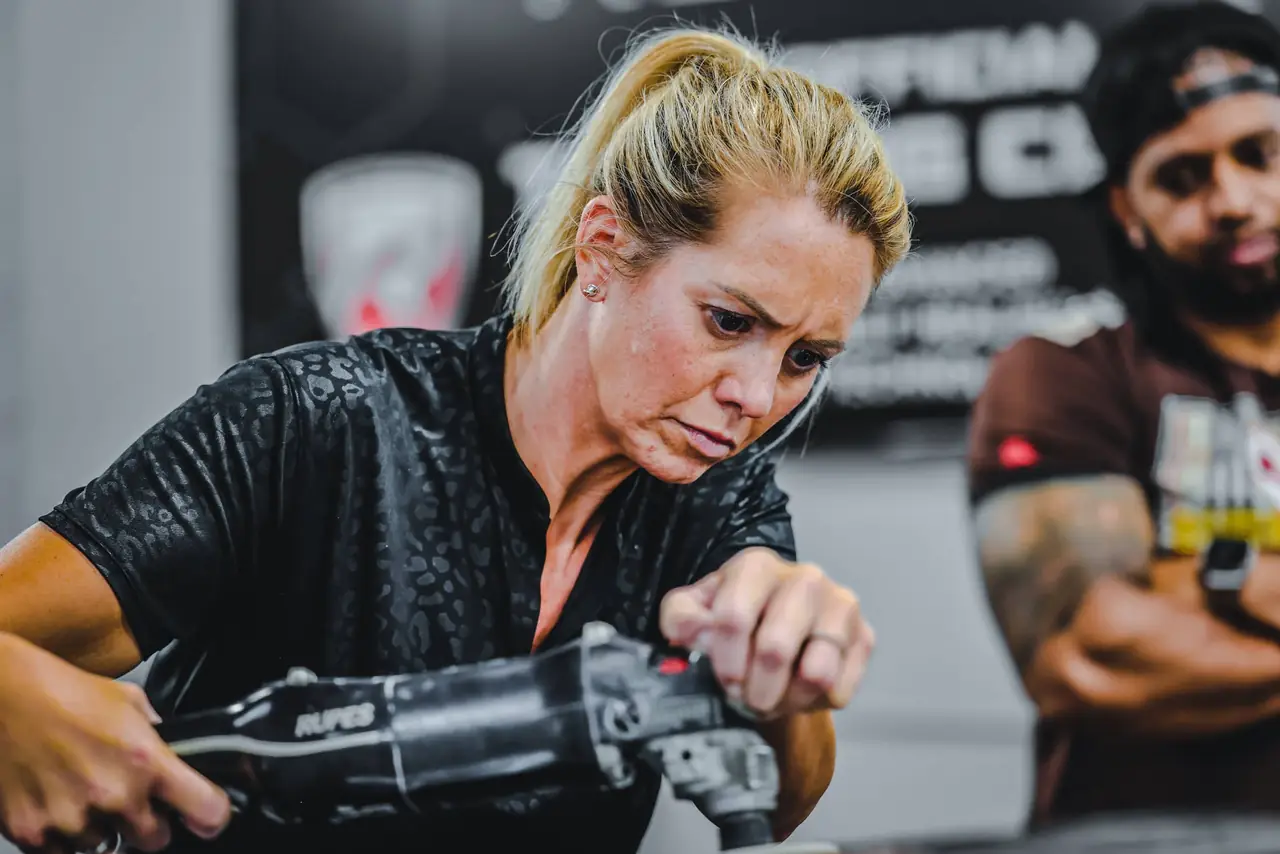
“Feather that edge once more and keep the lip contour. That one’s a four.”
What feedback sounds like at a DKTI bench
Coached at the bench, not lectured at.
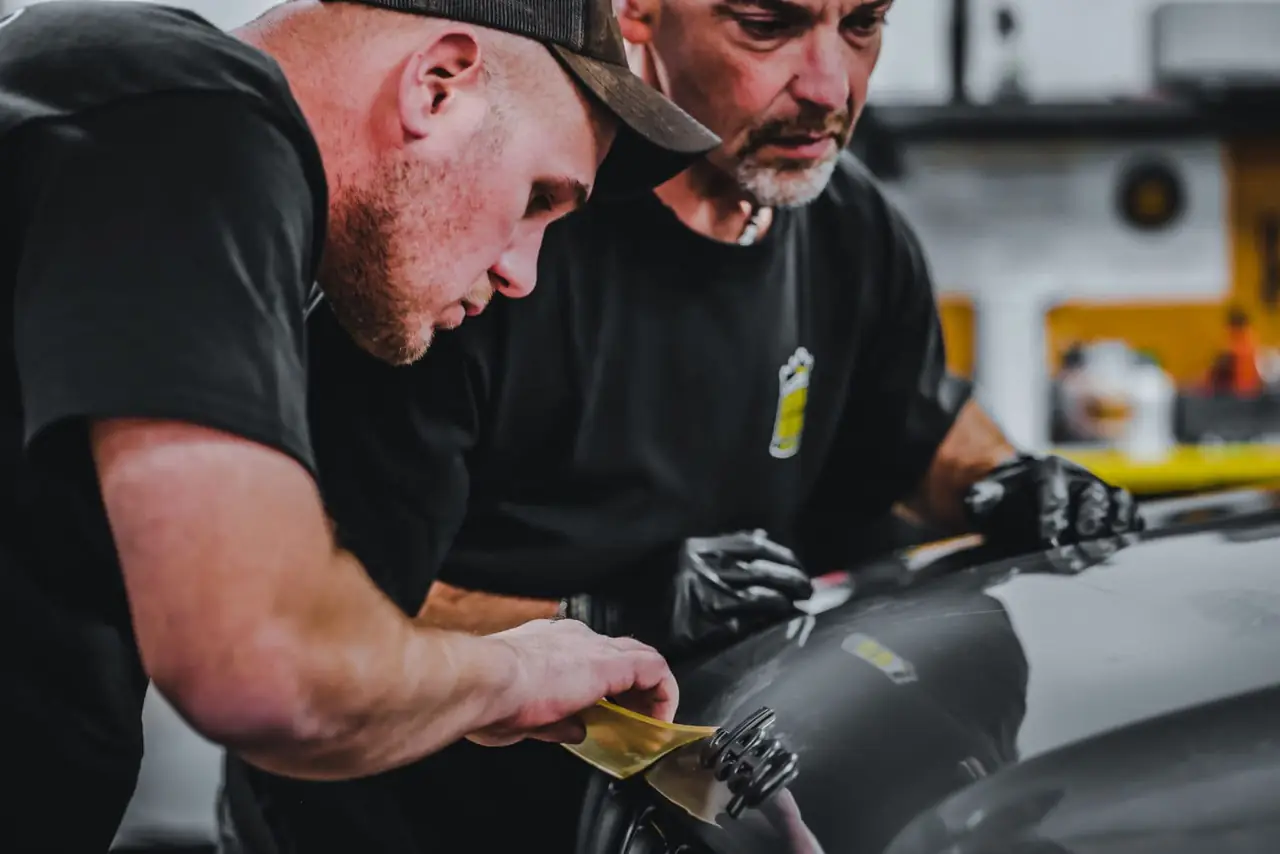
Our instructors are practicing technicians with more than a hundred years of experience between them. They demonstrate a repair, watch you do it, and score it skill by skill, writing notes at the end of every section so you know exactly what to practice that night.
When a safety decision comes up, they stop the work and explain it on the spot. That is how good habits get built before a bad one has a chance to form.
How every skill gets learned.
Demonstrate
Your instructor performs the step on a real wheel and talks through every decision out loud.
Practice
You do it yourself, first on training wheels and then on actual cars, with the instructor at your shoulder.
Rate
Each skill is observed and rated with written notes, so feedback is specific instead of vague.
Coach
Anything below a three gets focused coaching and another attempt until it meets the standard.
Sign off
Practical exams, the capstone wheel, and final instructor approval. Then you are certified.
The phone still gets answered.
Your first tricky hyper-silver match. A customer wheel you are unsure about. A dealer asking for a fleet price. Call us. Graduates can call their instructors with repair questions for as long as they are in business, and when you are ready, come back and climb from Certified Technician to Advanced Refinishing and Master.
Every student also gets Todd Sudeck’s personal number for one-on-one business consulting: (949) 981-3464.
First class from start to finish. The instructors, facilities, tools, and courses are all top-of-the-line. Learned an enormous amount while attending the wheel repair class and can’t wait to put my new skills into action. Thankful for all the new contacts and ongoing support offered by all of the instructors and the owner of Ding King.
07 // Professional equipment
Train with it. Leave with it.
The Ding King Alloy Wheel Repair System is complete. It includes everything you need to open for business on day one.
Thirty minutes. Wheel on the car.
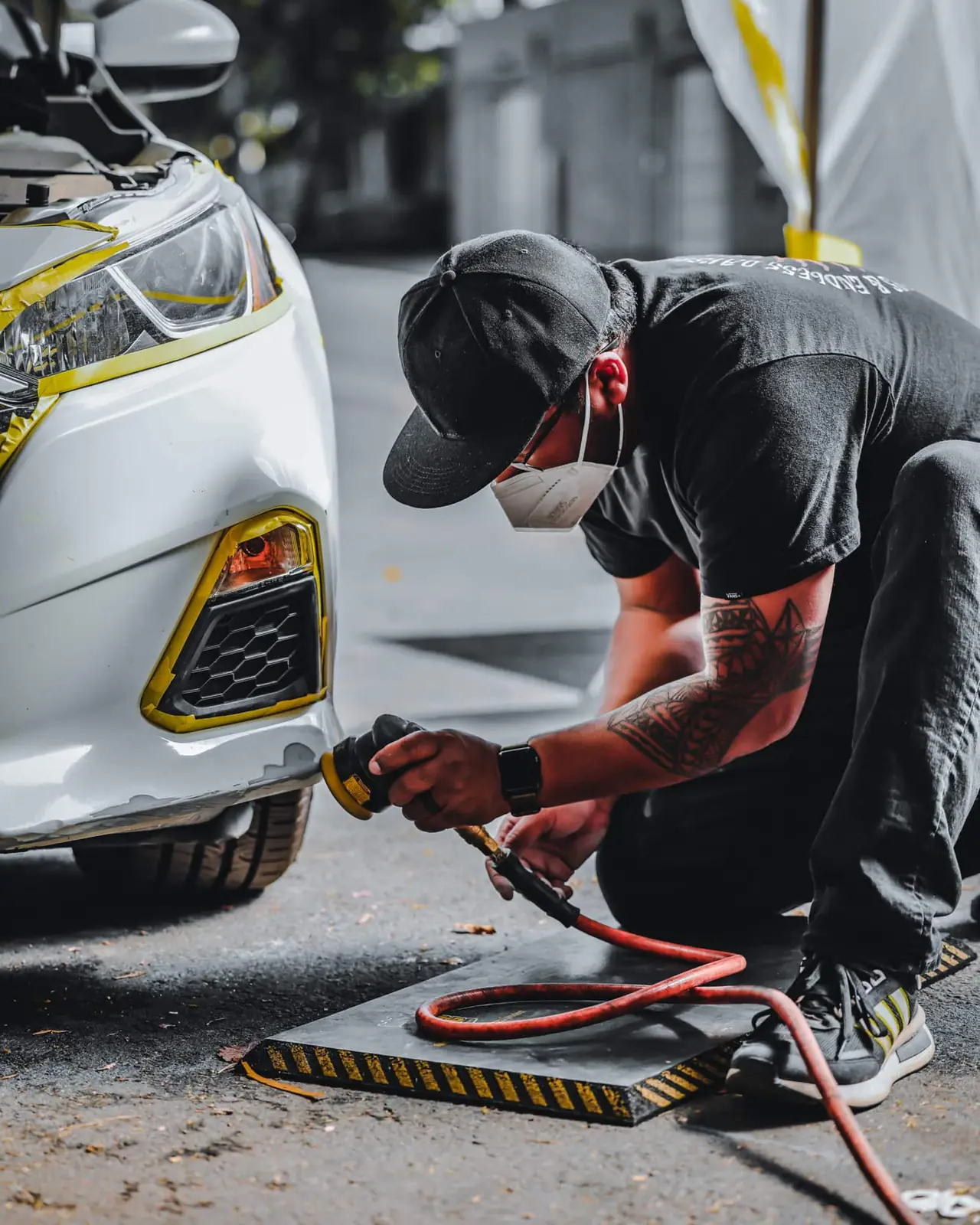
Our proprietary system lets you repair a wheel without taking it off the vehicle, which makes for a better experience for the customer and more jobs in your day. Restore scuffed and damaged wheels, or customize and repaint them in whatever color the customer wants.
It is built to travel to dealerships, car washes and driveways, and it is the same system you trained on, so nothing about your first job back home is new.
Inside the case.
Exact contents vary by package, and the current catalog has the full list. These are the categories every graduate goes home with.
Sanding and contour
Abrasives, blocks, and dual-action and precision sanders chosen for wheel lips and spokes.
Coatings
Primer, wheel-specific basecoats and clearcoats, and the equipment to apply them.
Masking
Materials that keep overspray off tires, valve stems, sensors and lug seats.
Inspection light
Lighting that shows damage, sanding marks and color mismatch before the customer can.
Reference manual
A thorough manual covering the repair for every type of damage, for the van or the shop.
Credentials
Your SkillVerify™ certification and Ding King Certified Graduate credentials.
08 // Business and marketing
Learn the repair. Then learn to sell it.
Every Ding King student takes the King’s business and marketing class and gets one-on-one consulting. You leave with a plan as well as a skill.
Set up the business
Choosing an LLC or sole proprietorship, insurance basics, and the customer authorization and warranty language you will use every day.
Estimate and price
Judge the difficulty, estimate labor and materials, and know when a spot repair, a full refinish or a replacement is the honest answer.
Win local accounts
The car wash and dealership approach that grew The Ding King to 275 technicians, adapted for wheels.
Get found online
A website, a Google Business Profile, organic search and pay-per-click campaigns aimed at customers near you.
Sell the repair
Explain realistic outcomes, finish care and limits so customers trust you and come back.
Add services
Stack add-ons such as scuffed bumpers, paint chips and headlight renewal for more profit per car.
The business and marketing program

Meet the King // The origin story
One car wash. Twenty-five percent.
Todd’s first account was a car wash doing about 350 cars a day. He offered free estimates in the service lane and gave the owner 25% of the gross. Five years later he was serving 27 car washes, hundreds of dealers and several rental car companies with 275 technicians. That playbook, adapted for wheel repair, is what you learn here.
Ask about Auto Recon Websites, estimating software, and the King of Car Care mobile app for quoting and booking jobs faster. See Auto Recon Websites and the KOCC App.
Student loans available.
Ask about student loans for your training, and about our all-inclusive packages that bundle airfare, hotel and ground transportation. We call it the Royal Treatment.
VA education benefits.
The Ding King is approved by CSAAVE to offer VA Education Benefits and supports Veterans Vocational Rehabilitation. The veteran-approved Total Recon #3 program includes alloy wheel repair training. Eligibility and coverage are determined by the VA.
Veterans program09 // Where we train
Four cities. One standard.
Classes start every Monday. All-inclusive packages can cover airfare, hotel, the airport shuttle and daily ground transportation.
Ask admissions which campus runs wheel repair on your dates.
Add services // More profit per car
Stack the next add-on
Classes start every Monday
Make the after your business.
Get trained. Get certified.
 Apply for a Student Loan